
The role of energy in the AI revolution
March 3, 2026
Carla Cico, GTWN international board member; TMC Editor-in-chief
Energy and human civilization are linked at the hip. Since the dawn of man, energy in its innumerable forms has been the foundation of the development of human society, whether it was the primitive fire warming a Stone-age encampment or a windmill producing flour to feed medieval cities.
The availability and efficiency of a society’s source of energy have indeed been the primary marker of development, and changes in this source are linked to the various “revolutions” that human society has undergone as part of its development process.
The first transition was from the pre-historic era – where fire and human muscle were the only available source of energy – to the Agricultural Revolution, when humanity settled down, developed farms and fixed abodes, and turned to domesticated animals as a source of energy to perform required tasks. In this case, the progression was clear: domesticated animals were a far more efficient source of energy than humans, possessing, greater strength and endurance, and were readily available in sufficient quantities.
Similar transitions have followed – from the “original” users of renewable energy such as watermills during the Iron Age and windmills in the Medieval period, to the Modern Age, which fundamentally transformed the human relationship with energy as a result of the Industrial Revolution. The most important inventions of this period, such as the steam engine, steam turbine and later internal combustion engine, all transformed how humans accessed and applied energy, with consequent impacts for the rest of society.
Today the primary source of energy is represented by burning fossil fuels (coal, oil, natural gas and propane-butane gas), combined, albeit in lesser quantity, with solar, wind, hydro energy, biomass and tidal energy.
In today’s world, energy consumption is ever-growing; not only for steadily expanding household use (electrical devices, vehicles, lighting, etc), but also for endless industrial and economic demands. At the top of this energy pyramid, however, we find the largest driver of forecast energy consumption: AI. Without more energy, AI cannot function, as it requires vast amounts of energy to power data centres, processors, and the surrounding digital infrastructure. For example, the International Energy Agency (IEA) expects AI-related electricity consumption to reach 945 terawatt-hours by 2030, which is more than the electricity consumption of the entirety of Japan today.
The Digital Revolution, therefore, just like the previous “Revolutions”, is inextricably linked to the use of energy, but in the reverse sense. It is no longer about accessing a new source of energy, but rather the emergence of a completely new activity in which to consume it. Due to the complexity of AI models, and the sheer volume of requests due to their ubiquity, AI’s energy consumption is so massive that it represents an important realignment in the traditional distribution of human energy consumption.
With the arrival of AI and its titanic demand for an uninterrupted flow of electrons, only a massive increase in the production of energy can sustain AI development and application at the pace that is expected by both AI users and AI investors.
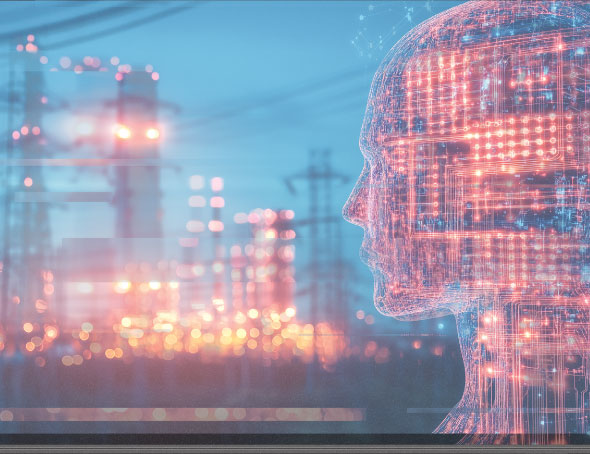
Therefore, we find ourselves in the situation where AI may indeed be the motor of the current economy (especially in the US), but electrical energy is the fuel. And without corresponding expansions in energy production infrastructure, we may find ourselves having constructed a marvellous engine of economic productivity – a metaphorical Ferrari – but be unable to properly derive its benefits due to a lack of fuel.
This should be a wakeup call for Governments, Energy Companies, regardless where they stand in the energy supply chain, and for the investment community to take quick and strong actions to reform the sector.
From one side, Governments, both local and federal should support the Companies with “ad hoc” regulations to allow quick intervention and to reduce the time needed to upgrade and/or to build new infrastructure and to lessen compliance policies to reduce the bureaucratic and economic burdens under which the Energy Companies are operating. From another side, Companies should take a more proactive attitude and act not just a “provider” but to regard themselves as a fundamental Player in the AI Revolution.
As for the investment community that is reluctant to invest in Energy projects because of their slower returns, they must understand that without these “slow returns” it is likely that the big investments in AI projects will be jeopardized in the future.
It should not come as a surprise if, sooner than later, one or more of the BIG TECH companies take the matter into their own hands and step into the Energy sector. They have the money and, most importantly, the motivation to do so.

Carla Cico is a GTWN Board member and a vastly experienced businesswoman who has worked in a number of highly responsible positions for internationally renowned firms throughout her illustrious career. She has been a pioneer in both digital and ESG implementation.
Carla held the position of CEO of Brasil Telecom, one of the largest telecoms operator companies in Brazil with a place on the New York Exchange. She was the first woman in South America to hold such a position.
Speaker in many international recognized Summits, with focus in Telecommunications, Management and Strategy, Digital Transformation and developing countries.


Connectivity and the Quadruple Transformation: The new architecture of power
Michele M. Merrell, Principal & Founder, Strategic Advisor, Aethra Global; GTWN President, Americas...

The trust gap in a synthetic world: Why telecom carriers can no longer sit this one out
Leticia Latino van-Splunteren, CEO of Neptuno USA Corp; Co-founder of Albireo AI; GTWN...


